 Guides
Illustrative licensed food photograph, not an official Golden Corral product or evidence of US portions, current availability or prices.Green bean and onion casserole. Photo: kevin dooley · Source · CC BY 2.0 · Display cropped to fit.
Golden Corral sources and plate planning
Official US nutrition database checked 2026-11-15. No separate nutrition effective date confirmed. These are published recipe servings, not weighed buffet portions or guaranteed local offerings. Plate totals are calculated estimates. Blank allergen records do not mean allergen-free. Unconfirmed admission prices remain Varies.
Golden Corral official nutrition database ↗What this guide covers
- Begin with the specific condition you need met
- Read the official information before calling
- Know what a contains statement can establish
- Keep wheat avoidance and gluten avoidance distinct
- Call the restaurant that will prepare your food
- Ask about shared fryers directly
- Investigate grills, griddles, and preparation surfaces
- Account for the buffet’s serving environment
- Treat sauces and seasonings as full ingredients
- Check salads, sides, and desserts separately
- Use a short script to reduce ambiguity
- Prepare children and companions for the plan
- Use nutrition tools only after suitability is established
- Make room for a decision not to dine
Begin with the specific condition you need met
A useful gluten or allergen conversation starts with the ingredient you must avoid and the level of handling information you need. Celiac disease, a wheat allergy, another food allergy, and a personal preference to avoid gluten are not interchangeable situations. You do not need to share private medical details beyond what helps the restaurant understand your request, but you should name the relevant food or ingredient clearly. Asking whether the buffet has healthy food or gluten-friendly choices leaves too much room for interpretation. The central question is whether the restaurant can verify suitable ingredients and explain the preparation and service conditions for particular foods. A broad menu category cannot answer that question by itself.
Read the official information before calling
Golden Corral publishes item-level nutrition and allergen information through its official nutrition page. Use it to identify candidate foods and note the exact names you want to discuss. Read any accompanying allergen statement as well as the individual entries. The purpose is to prepare a focused conversation, not to declare an item suitable without local confirmation. Online data can describe a standard recipe while leaving questions about the restaurant’s current product, substitutions, and handling. If two entries look similar but list different ingredients or allergens, do not choose the more convenient one without understanding which matches the food being served. Bring the item names and your unresolved questions to the restaurant.
Know what a contains statement can establish
An allergen statement is useful evidence about a listed recipe, but it does not describe every aspect of preparation or service. A food may have no listed ingredient you avoid and still encounter that ingredient through shared equipment, utensils, or nearby food. Conversely, a contains statement that names your allergen is a direct reason to investigate another option, not an invitation to remove the visible part. Do not scrape off a topping and assume the remaining food is appropriate. Ask whether the full current ingredient information can be checked for the exact preparation. If a label is incomplete, unfamiliar, or inconsistent with another source, treat that as a question to resolve rather than proof that the food is suitable.
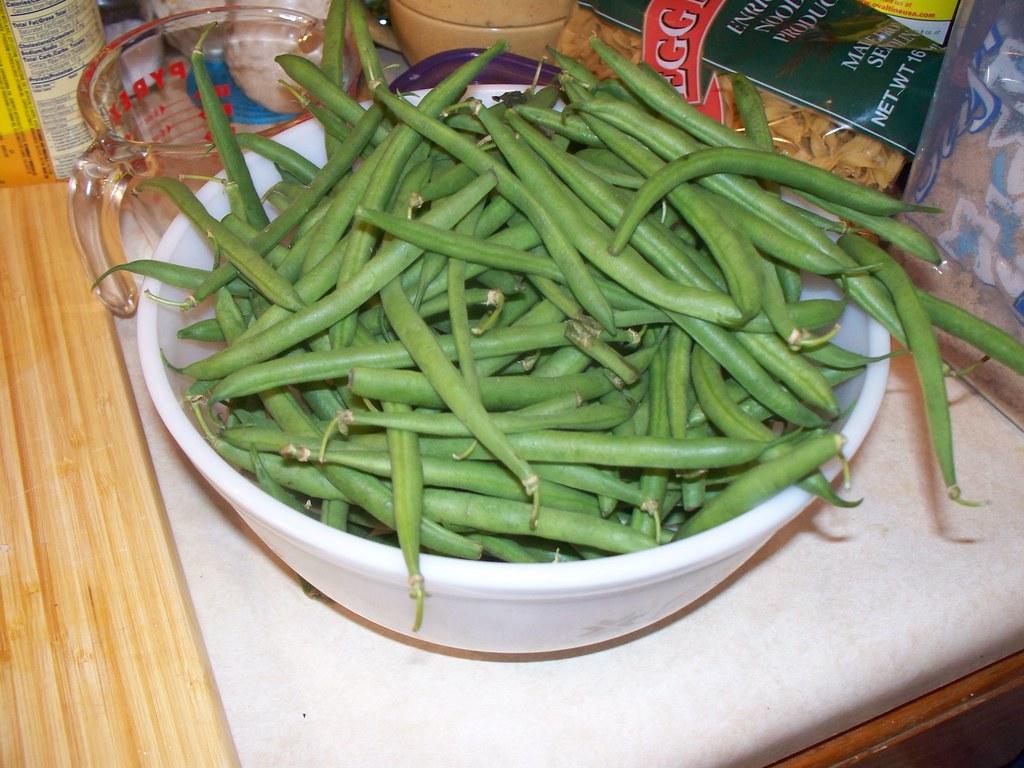
Illustrative licensed food photograph, not an official Golden Corral product or evidence of US portions, current availability or prices.Green Beans. Photo: kuljuls · Source · CC BY 2.0 · Display cropped to fit.
Keep wheat avoidance and gluten avoidance distinct
Wheat is relevant to gluten avoidance, but a wheat-focused ingredient check does not by itself address every gluten-containing grain or ingredient. A product described as wheat-free should not automatically be treated as gluten-free. Similarly, someone with a wheat allergy may need an assessment that differs from a general gluten-free preference. Tell staff which requirement applies and ask about the complete recipe rather than relying on a single word in a menu description. Sauces, seasonings, coatings, and mixed dishes deserve attention alongside obvious bread products. Your clinician or dietitian can explain the requirements of your own condition; the restaurant’s role is to provide accurate information about its food and procedures so you can make an informed decision.
Call the restaurant that will prepare your food
Use the location finder and contact information described in the official FAQ to reach the branch you intend to visit. Ask to speak with a manager or another person who can verify ingredient and preparation details. A national customer-service answer may explain policy, but it cannot necessarily establish what equipment or products a particular kitchen is using that day. Give your expected visit date and meal period, then ask whether someone knowledgeable will be available on arrival. Calling ahead is preparation, not final clearance. Confirm the relevant details again before eating, especially if the staff, menu, or circumstances differ from what was discussed on the phone.
Ask about shared fryers directly
Fried food requires a specific equipment question: is it cooked in oil or a fryer shared with foods containing the ingredient you need to avoid? Do not infer the answer from whether the food itself is breaded. Unbreaded foods can share equipment with breaded products or other allergen-containing items. Ask about the actual fryer arrangement for the specific food and restaurant. If staff cannot verify it, consider the uncertainty unresolved. Do not assume that high cooking temperatures remove allergen proteins or eliminate gluten-related concerns. The relevant issue is the restaurant’s process and whether it meets your needs, not whether the food looks plain after cooking or has no coating visible on its surface.
Illustrative licensed food photograph, not an official Golden Corral product or evidence of US portions, current availability or prices.Green Beans. Photo: JeepersMedia · Source · CC BY 2.0 · Display cropped to fit.
Investigate grills, griddles, and preparation surfaces
A grilled or made-to-order item may sound easier to evaluate than a mixed buffet dish, but shared surfaces introduce their own questions. Ask what else is cooked on the equipment, what utensils are used, and whether any separate preparation procedure is realistically available. A request for no bun does not address seasonings, marinades, butter, sauces, or contact with other foods. Likewise, a custom egg dish may still be prepared with shared tools or ingredients. Ask for a concrete description instead of a promise that the kitchen will be careful. If the restaurant cannot provide a process you can evaluate confidently, select a different dining plan rather than assuming customization resolves the concern.
Account for the buffet’s serving environment
Buffet service adds handling questions beyond the kitchen. Guests may move utensils, spill toppings, or place food from one container near another. Staff may be able to explain how the station is maintained, but that does not turn the buffet into a controlled allergen-free environment. Ask whether any alternative service arrangement can be provided and what limitations remain. Do not assume that taking food from the back of a pan or waiting for a refill eliminates the concern. Those actions do not establish how the food was prepared or handled before it reached the station. The practical decision is whether the available information and procedures are appropriate for your own needs.
Treat sauces and seasonings as full ingredients
Sauces, gravies, dressings, marinades, and seasoning blends can contain ingredients that are not apparent from the main food. A plain-looking meat or vegetable can therefore require more investigation than its appearance suggests. Ask whether the item has been marinated, brushed, coated, or finished with another product, and whether the ingredients of that product can be verified. Do not rely on color or thickness to identify what a sauce contains. A clear sauce is not automatically free of wheat or soy, and a dairy-colored sauce is not a complete description of its allergens. The same principle applies to table condiments and toppings you add yourself: they belong to the final food assessment.

Illustrative licensed food photo, not an official Golden Corral product, portion or price.Wooden Fruit Bowl. Photo: Smabs Sputzer (1956-2017) · Source · CC BY 2.0 · Display cropped to fit.
Check salads, sides, and desserts separately
A salad bar is not automatically a simpler environment for allergy management. Prepared salads can contain multiple ingredients, dressings may have their own allergens, and shared serving utensils raise handling questions. Hot sides can involve broths, butter, coatings, or sauces. Desserts may combine cake, filling, frosting, garnish, and shared scoops or tongs. Evaluate the specific food you want rather than assuming an entire station is suitable or unsuitable. A dietary label such as vegetarian, plant-based, sugar-free, or no-added-sugar does not answer gluten or allergen questions. If you need several exclusions at once, name each one clearly so the restaurant does not verify only the most obvious ingredient and overlook another requirement.
Use a short script to reduce ambiguity
A clear opening might explain that you need to avoid a named ingredient and need both recipe and handling information before deciding whether to eat. Follow with the exact dishes you are considering. Ask who can check the current ingredients, whether shared fryers or surfaces are involved, and whether the serving process introduces additional concerns. Repeat back the answer in plain language if anything is unclear. This is not about testing staff with technical language or demanding a guarantee they cannot provide. It is about obtaining concrete information. If the response remains vague, contradictory, or based only on appearance, ask for clarification once and be prepared to choose another meal arrangement if the uncertainty remains.
Prepare children and companions for the plan
When a child or another family member has a dietary medical need, discuss the plan before arriving. Agree that no one will offer tastes, share utensils, or bring food to that person’s plate without checking. If the restaurant cannot meet the necessary conditions, having an alternative already in mind reduces pressure to accept an uncertain option because everyone else is ready to eat. Follow the emergency plan and medication guidance provided by the person’s healthcare team. A restaurant article cannot replace that advice or predict how an exposure might affect someone. The goal of planning is clearer communication and fewer rushed decisions, not a promise that a buffet can be made appropriate for every allergy or gluten-related condition.
Illustrative licensed food photo, not an official Golden Corral product, portion or price.fruit bowl, apples and oranges. Photo: Hobbies on a Budget · Source · CC BY 2.0 · Display cropped to fit.
Use nutrition tools only after suitability is established
The Golden Corral nutrition calculator can help compare nutrients among foods you have already determined are appropriate to consider. It is not an allergen-clearance tool and cannot verify a local kitchen’s equipment, substitutions, or serving practices. A favorable calorie, carbohydrate, or protein total says nothing about whether an ingredient exposure is acceptable for your condition. Keep those decisions in the right order: identify the food, verify the relevant information locally, decide whether the conditions meet your needs, and only then use nutrition data if it is helpful. If no suitable meal can be established, a calculator should not be used to persuade you that a nutritionally attractive combination is worth the unresolved concern.
Make room for a decision not to dine
The most useful outcome of research is an informed decision, which may be to eat elsewhere. You do not need to prove that every possible option is unsuitable before deciding the available information is insufficient for your needs. Check the Golden Corral menu and prices guide for general planning, but let verified ingredients and actual handling procedures determine whether the visit works. Avoid relying on another diner’s successful experience as evidence that your meal will meet the same conditions. Recipes, equipment, service, and individual requirements can differ. Clear questions, direct local answers, and a practical alternative provide a stronger foundation than a list of foods presented as universally safe.
See the full Golden Corral menu
Prices, calories and macros for every item, or build a meal in the calculator.
Sources and corrections
Nutrition figures on Well.now come from official US restaurant sources, linked on each brand page with a last-checked date. Prices use verified local amounts first, then clearly labeled sourced estimates; Varies appears when neither is available. See our sources and methodology, or email be@well.now with a correction.
About the Well.now Editorial Team
This article was written and fact-checked by the Well.now Editorial Team. We check nutrition claims against each chain's official US information and never publish prices we cannot confirm. Well.now is independent and not paid by any restaurant. Read our editorial policy.