 Nutrition
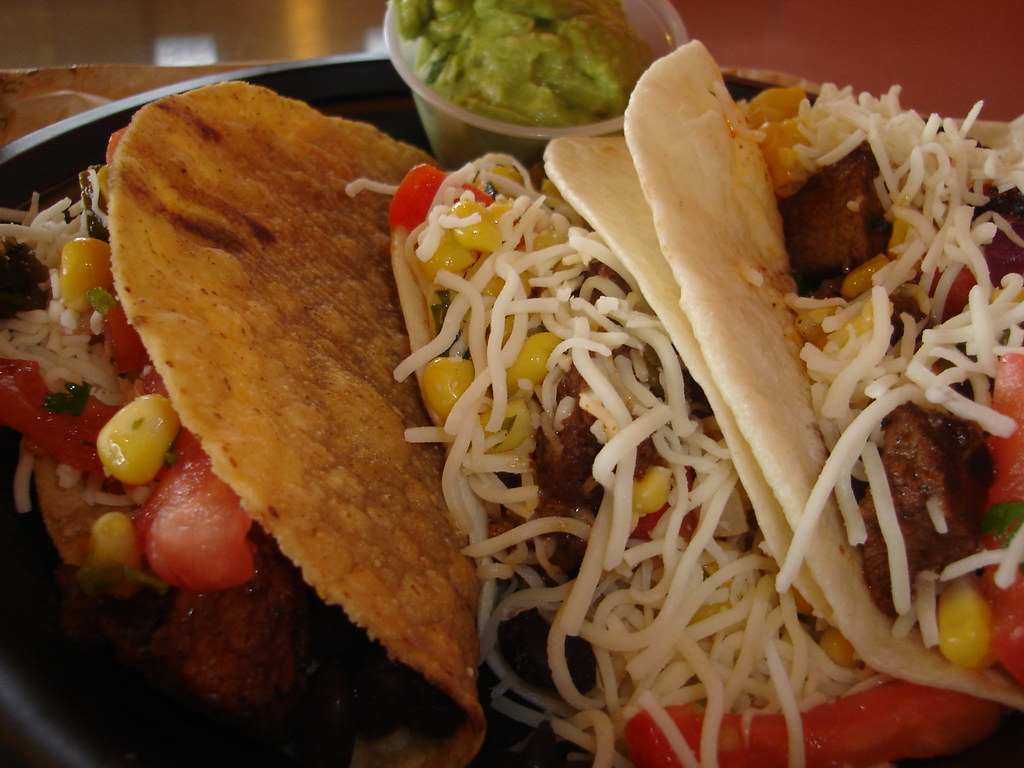
Historical QDOBA photograph from a free licensed collection. Not evidence of current menu availability, serving size or price.3 Steak Tacos at Qdoba. Photo: Shoshanah · Source · CC BY 2.0 · Display cropped to fit.
A chicken bowl, ingredient by ingredient
| Item / serving | Cal | Protein | Carbs | Fat | Sodium |
|---|---|---|---|---|---|
| Cilantro Lime Rice (4 oz.) | 190 | 3 g | 38 g | 2.5 g | 390 mg |
| Black Beans (4 oz.) | 140 | 9 g | 24 g | 1 g | 330 mg |
| Grilled Adobo Chicken (3.5 oz.) | 190 | 19 g | 2 g | 12 g | 440 mg |
| Pico de Gallo (1 oz.) | 5 | 0 g | 1 g | 0 g | 70 mg |
Chicken bowl
525
calories
Same burrito
825
calories
Tortilla difference
+300
calories
Official US portions · checked Nov 8, 2026February 2026 brochure
Build this orderWhat this guide covers
- Why a QDOBA bowl does not have one calorie count
- Start with the format, not the toppings
- Rice and beans are separate decisions
- Choose protein with the whole meal in mind
- Queso, guacamole and dairy toppings still count
- Salsa and vegetables are not a reason to ignore sodium
- A practical way to compare two bowls
- Remember the drink and sides
- How to interpret dates and estimate labels
- Questions to answer before ordering
- Worked example: a 525-calorie chicken bowl
- Bowl versus burrito: hold the filling constant
- What one topping does to the baseline
- Brown rice versus cilantro lime rice
Why a QDOBA bowl does not have one calorie count
A QDOBA bowl is an order you assemble, not a single fixed recipe. Rice, beans, protein, queso, guacamole and salsa all contribute to the finished meal. Searching for QDOBA bowl calories can therefore produce several different answers that are all describing different orders. The useful question is not how many calories are in a bowl in general. It is which ingredients, serving sizes and extras are included in the bowl you plan to eat.
This guide explains how to read those choices and compare them in the Well.now QDOBA nutrition calculator. Our information covers US restaurants only. The calculator identifies its nutrition source and the date we checked it. A source check is not a promise that every restaurant currently serves every listed ingredient. Where current figures cannot be confirmed, estimates remain estimates rather than being promoted to verified facts. Check QDOBA's official nutrition and allergens page when a recipe or medical requirement makes an exact ingredient detail important.
Start with the format, not the toppings
A bowl holds the filling without a large enclosing tortilla. A burrito adds a tortilla to those fillings. A salad changes the base, but dressing and other toppings can still contribute meaningfully to its total. Comparing a bowl with a burrito is most useful when you keep the ingredients inside the same. Otherwise, you might attribute the difference to the format when one order actually contains more rice, extra protein or an additional sauce.
In the calculator, choose your format first and continue through the ingredient steps. Do not add a separate tortilla if your chosen format already includes it. If you order a tortilla on the side, count it separately and decide how much you actually eat. The same principle applies to chips: a side served in its own bag does not disappear from the meal total just because it is outside the bowl. Format is the starting point, not the whole calculation.
Rice and beans are separate decisions
Rice changes the carbohydrate and calorie content of an order. Beans contribute carbohydrates and protein as well, so a rice-and-bean bowl should include both portions in its calculation. White rice and brown rice are not interchangeable nutrition entries simply because their scoops look similar. Use the actual option named in the source. Likewise, black beans and pinto beans should be treated as separate choices rather than assigned the same numbers by assumption.
If you ask for light rice, the amount served is not a standardized measurement you can know from the ordering phrase alone. A half-portion calculation is a planning estimate. It can help compare possibilities, but it should not be described as an official light-rice recipe unless the chain publishes that specific serving. The Well.now builder labels changes away from the documented standard portion as estimates. This distinction matters more than displaying a precise-looking total that hides how the portion was chosen.
Choose protein with the whole meal in mind
Chicken, steak and other available proteins have their own nutrition profiles. The highest-protein choice is not necessarily the lowest-calorie choice, and neither is automatically the best choice for every diner. Start with the flavor and portion you want, then look at protein, calories, fat and sodium together. Comparing only protein can miss a sauce or topping that changes the finished bowl more than changing the meat would.
Extra protein should be counted as additional food. If the calculator models a double serving by multiplying a standard ingredient entry, the resulting total is an estimate of that larger serving, not an independently published restaurant meal. Ask the restaurant about the actual extra portion and its charge. If your local menu offers a seasonal protein absent from our builder, do not substitute another meat's numbers and treat them as verified. Check the official information for that item or leave its nutrition unavailable.
Queso, guacamole and dairy toppings still count
Queso, guacamole, shredded cheese and sour cream are separate ingredients. Their contribution belongs in the total whether a particular restaurant includes them in the price or charges for them. A topping being included in an offer says nothing about its calories. Count each portion that you choose, and avoid assuming that all queso products or all guacamole portions have identical nutrition across different restaurant chains.
When deciding between several rich toppings, compare the meal with each added individually before stacking them together. That makes the trade-off visible without turning your lunch into a list of forbidden foods. You might keep the topping you enjoy most and skip another, or order one on the side. If you eat only part of a side cup, the fraction you enter is an estimate unless you measure it. A calculator can show that assumption clearly, but it cannot measure the cup for you.
Historical QDOBA photograph. Not evidence of current US menu availability, portions or prices.Qdoba's Naked Burrito Bar. Photo: college.library · Source · CC BY 2.0 · Display cropped to fit.
Salsa and vegetables are not a reason to ignore sodium
Fresh salsa, cooked salsa, pickled toppings and vegetables can look similar on a calorie summary while differing in sodium. Low calories do not establish low sodium. Seasoning, brining and recipes all matter. Use the sodium column alongside the calorie and macro summary when comparing your bowl, especially if you also plan to eat another restaurant meal later in the day.
Choosing several salsas means adding several source portions, not replacing one salsa with another unless you actually remove the first. The same rule applies to fajita vegetables or other available additions. For an allergy, ingredient sensitivity or medically prescribed sodium target, consult the chain's current written information and your care professional. Our builder is a comparison tool. It does not identify cross-contact risk, certify allergen safety, or determine what sodium intake is appropriate for you. A favorable calorie total does not answer those separate questions.
A practical way to compare two bowls
Make your usual bowl first. Choose the same format, rice, beans, protein, sauces and toppings you would order at the counter. Review the ingredient list before calculating so you can catch duplicate sides or a missed sauce. Once you have a baseline, return to the ingredient flow and change one decision at a time. Removing the tortilla, changing rice quantity or choosing a different topping is easier to understand when everything else stays constant.
Compare the results across calories, protein, carbs, fat and sodium rather than looking for one winning number. A change that reduces calories may also reduce protein; another might leave calories similar but change sodium. These are practical differences, not a scoring system for good and bad meals. If you are sharing chips or saving part of the bowl, record that separately as a portion assumption. The restaurant's published standard serving remains the reference, while what you personally eat may differ.
Remember the drink and sides
A bowl-only calculation is not a full order if you also choose a drink, chips, a dip or dessert. Add only the sides with source-supported nutrition entries. Do not assign a generic soda value to an unspecified cup size, since the drink, ice and refill choices can differ. Water does not need a speculative restaurant nutrition entry, and an item we have not confirmed should remain unavailable instead of being given a plausible-looking placeholder.
Shared sides require a separate decision about your share. A bag's label may describe the entire package or a smaller serving. Read that serving before dividing it. If you are estimating that you ate half, call it an estimate. Prices are separate from nutrition: our QDOBA prices show Varies unless confirmed for a named restaurant and ordering context. A dip included with a particular purchase is not evidence that the same offer exists at every US location.
How to interpret dates and estimate labels
The date beside a source tells you when we checked that document. Its publication date tells you when the restaurant issued the underlying information. Those dates can be different. An older official document may help explain ingredients but cannot, by itself, prove a current recipe. A current check date must not hide the age of the source or turn historical values into a freshly verified menu.
Read the source label before relying on a total. Standard ingredient values are source-based; a combination is an arithmetic sum of those values; nonstandard portions introduce additional assumptions. If the underlying source is not confirmed current, the total remains an estimate even with regular portions. Rounding also means calories may not exactly equal a calculation made from rounded grams of protein, carbohydrate and fat. We retain the source's published calorie figure rather than silently rewriting it to force an exact match.
Questions to answer before ordering
Is your planned protein available at this restaurant? Is the tortilla already counted? Are you adding both rice and beans? Does the queso portion match the ingredient entry, or are you buying a separate side? Will you eat the full bag of chips? These questions make a nutrition calculator more useful than copying a single bowl number from a search result. The answers describe your meal, rather than somebody else's photograph or receipt.
Build your order in the QDOBA calculator, check the summary and source, then use QDOBA's official ordering service to confirm availability and local price. You can also visit our QDOBA menu page for the listed ingredient entries and our community page for dated diner experiences. Report an outdated source or incorrect transcription to be@well.now with the item, source link and serving size. A clear correction is more helpful than a competing number without its recipe. Keep the comparison specific, and the bowl total becomes a usable planning reference rather than a universal claim.
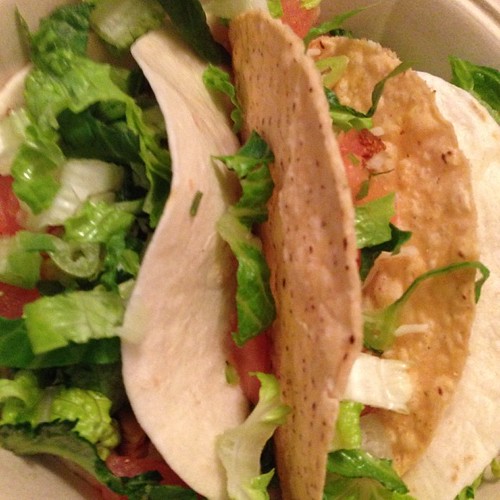
Historical QDOBA photograph. Not evidence of current US menu availability, portions or prices.#Hardshell #Softshell Tacos combination at #Qdoba #Tacos #MexicanFood #foodporn. Photo: GlobalGoodNetworks · Source · CC BY 2.0 · Display cropped to fit.
Worked example: a 525-calorie chicken bowl
Here is a specific build you can reproduce in the calculator: a bowl with cilantro lime rice (4 oz), black beans (4 oz), grilled adobo chicken (3.5 oz) and pico de gallo (1 oz). QDOBA's February 26, 2026 brochure lists those portions at 190, 140, 190 and 5 calories respectively. Adding the four published entries gives 525 calories, 31 grams of protein, 65 grams of carbohydrate, 15.5 grams of fat and 1,230 milligrams of sodium. This is a Well.now calculated combination, not an official signature entrée named Chicken Bowl.
The ingredient breakdown is equally important: rice contributes 3 grams of protein and 390 milligrams of sodium; black beans contribute 9 grams of protein and 330 milligrams of sodium; chicken contributes 19 grams of protein and 440 milligrams of sodium; pico contributes no listed protein and 70 milligrams of sodium. These are standard source portions. They describe the assumptions behind the total, not a weighed measurement of the food served at your restaurant.
Bowl versus burrito: hold the filling constant
Keep that same chicken, rice, black bean and pico filling and add QDOBA's published 12.5-inch flour tortilla. The tortilla contributes 300 calories, 8 grams of protein, 52 grams of carbs, 7 grams of fat and 760 milligrams of sodium. The resulting calculated burrito is 825 calories, 39 grams of protein, 117 grams of carbs, 22.5 grams of fat and 1,990 milligrams of sodium. Now the comparison isolates the tortilla instead of confusing a change of format with a change of filling.
The 10-inch flour tortilla is a different source portion at 210 calories, while a 5.5-inch tortilla is listed at 70 calories. Do not choose whichever tortilla figure produces the result you prefer. Match the size used for your order. Our bowl-versus-burrito comparison uses the large 12.5-inch tortilla explicitly. If the local restaurant supplies a different size or you eat only part, the calculation must change and the portion assumption should stay visible.
What one topping does to the baseline
The documented 2-ounce Three Cheese Queso portion adds 80 calories, 3 grams of protein and 340 milligrams of sodium. Added to the worked chicken bowl, that makes 605 calories, 34 grams of protein and 1,570 milligrams of sodium. A 2-ounce guacamole portion instead adds 80 calories, 1 gram of protein and 160 milligrams of sodium, resulting in 605 calories, 32 grams of protein and 1,390 milligrams of sodium. Similar calorie changes can therefore have different protein and sodium effects.
Shredded cheese at 1 ounce adds 110 calories, 7 grams of protein and 180 milligrams of sodium. Sour cream at 1 ounce adds 50 calories, 1 gram of protein and 10 milligrams of sodium. Fajita vegetables at 2 ounces add 40 calories, 1 gram of protein and 115 milligrams of sodium. Pick the flavor you want, then compare its contribution rather than lumping every topping into one generic estimate. If the full signature recipe already includes a topping, do not add it again unless you are ordering extra.
Brown rice versus cilantro lime rice
The brochure lists cilantro lime rice at 190 calories, 3 grams of protein, 38 grams of carbs, 2.5 grams of fat and 390 milligrams of sodium for 4 ounces. Seasoned brown rice at the same named serving is 170 calories, 4 grams of protein, 36 grams of carbs, 1.5 grams of fat and 250 milligrams of sodium. Replacing the rice in our baseline bowl changes the total to 505 calories, 32 grams of protein, 63 grams of carbs, 14.5 grams of fat and 1,090 milligrams of sodium.
Those differences apply to these QDOBA source recipes and servings, not every white or brown rice sold by every restaurant. Brown rice is not a blanket guarantee of a healthier order. Adding queso, chips or extra meat afterward may change the total much more than the rice substitution. The comparison is most informative when you make one change at a time and keep the original serving assumptions visible.
See the full QDOBA menu
Prices, calories and macros for every item, or build a meal in the calculator.
Sources and corrections
Nutrition figures on Well.now come from official US restaurant sources, linked on each brand page with a last-checked date. Prices show only when confirmed at a named location. See our sources and methodology, or email be@well.now with a correction.
About the Well.now Editorial Team
This article was written and fact-checked by the Well.now Editorial Team. We check nutrition claims against each chain's official US information and never publish prices we cannot confirm. Well.now is independent and not paid by any restaurant. Read our editorial policy.