 Nutrition
Illustrative licensed food photograph, not an official QDOBA product or evidence of current US portions, availability or prices.Guacamole Dip. Photo: Kjokkenutstyr.net · Source · CC BY-SA 2.0 · Display cropped to fit.
Official portions for this comparison
| Item / serving | Calories | Protein | Carbs | Fat | Sodium |
|---|---|---|---|---|---|
| Three Cheese Queso (2 oz.) | 80 | 3 g | 3 g | 8 g | 340 mg |
| Tortilla Chips (4 oz.) | 560 | 7 g | 75 g | 26 g | 220 mg |
| Tortilla Strips (0.5 oz.) | 70 | 1 g | 8 g | 4.5 g | 35 mg |
Ingredient portions are not complete entrées. Standard-portion combinations are calculated totals; changed portions are estimates. US source published February 26, 2026, checked November 8, 2026. Prices remain Varies without a verified local amount.
Official nutrition brochureWhat this guide covers
- How many calories are in QDOBA chips?
- The source and what its serving actually means
- Useful fractions of the 4-ounce reference
- Why a chip count is not a reliable serving size
- Chips with Three Cheese Queso
- Chips with guacamole or Queso Diablo
- Equal calories can hide a different comparison
- Use the published dip size rather than forcing a multiplier
- Sharing the entire combination equally
- When your chips share and dip share are different
- Put the side back into the full meal
- FAQ: Are tortilla strips the same as chips?
- FAQ: Does ordering dip on the side reduce calories?
- FAQ: What is the simplest way to log shared chips?
How many calories are in QDOBA chips?
QDOBA tortilla chips have 560 calories per published 4-ounce serving. That serving also lists 7 grams of protein, 75 grams of carbohydrates, 26 grams of fat and 220 milligrams of sodium. These numbers describe the chips alone, before queso, guacamole or another dip. They do not establish that every bag handed across the counter contains exactly 4 ounces. For a useful calculation, first identify whether you are counting the documented serving, a measured amount or an estimated share of the food you received. A complete chips-and-dip total needs a separate entry for the dip, including its portion size. The serving description matters as much as the calorie number, especially when several people eat from the same bag.
The source and what its serving actually means
The reference is the QDOBA US Nutrition Brochure published February 26, 2026, with the source record checked November 8, 2026. This article covers US nutrition entries only. A source-check date identifies the document reviewed; it does not mean someone weighed a bag from your restaurant that day. Keep the distinction between an official ingredient entry and your personal serving calculation visible. The 560-calorie figure is published nutrition for 4 ounces. A calculation for 2 ounces, a third of a bag or a handful is a portion estimate derived from that entry. Local packaging and the amount actually eaten still need to be established. Neither a photograph nor the word side proves the weight of your portion.
Useful fractions of the 4-ounce reference
Using proportional estimates, half the published chips serving is 2 ounces and 280 calories. One quarter is 1 ounce and 140 calories. Three quarters is 3 ounces and 420 calories. Half also works out to 3.5 grams of protein, 37.5 grams of carbohydrates, 13 grams of fat and 110 milligrams of sodium. A quarter gives an estimated 1.75 grams of protein, 18.75 grams of carbohydrates, 6.5 grams of fat and 55 milligrams of sodium. These are mathematical divisions of rounded published values, not separately tested QDOBA portions. Reporting 18.75 grams does not make a visually estimated quarter more accurate. For everyday tracking, keep the underlying fraction clear rather than treating the extra decimal places as evidence of measurement.
Illustrative licensed food photograph, not an official QDOBA product or evidence of current US portions, availability or prices.Guacamole. Photo: Kjokkenutstyr.net · Source · CC BY-SA 2.0 · Display cropped to fit.
Why a chip count is not a reliable serving size
The source defines chips by weight, not by a fixed number of pieces. Broken chips, large pieces and small pieces make a count-based conversion uncertain. There is no supported universal answer here for calories in ten QDOBA chips. If you want to use the official reference more closely, weigh the portion you intend to eat and calculate its fraction of 4 ounces. For example, a measured 1.5-ounce portion is three eighths of the reference, giving an estimated 210 calories. Without a scale, describing your amount as roughly one quarter or one half is more transparent than inventing a calories-per-chip figure. Counting a pile of fragments as whole chips would only add another assumption without improving the estimate.
Chips with Three Cheese Queso
Three Cheese Queso has separate published entries for 2 ounces and 4 ounces. The 2-ounce entry lists 80 calories, 3 grams of protein, 3 grams of carbohydrates, 8 grams of fat and 340 milligrams of sodium. Add that to 4 ounces of chips and the component sum is 640 calories, 10 grams of protein, 78 grams of carbohydrates, 34 grams of fat and 560 milligrams of sodium. The 4-ounce queso entry lists 170 calories, making the chips-plus-queso sum 730 calories. That larger combination totals 13 grams of protein, 80 grams of carbohydrates, 43 grams of fat and 890 milligrams of sodium. These are sums of named servings, not proof of the quantities in a particular purchased bundle.
Chips with guacamole or Queso Diablo
Hand Crafted Guacamole lists 80 calories for 2 ounces, with 1 gram of protein, 5 grams of carbohydrates, 8 grams of fat and 160 milligrams of sodium. Combined with the full chips reference, that makes 640 calories, 8 grams of protein, 80 grams of carbohydrates, 34 grams of fat and 380 milligrams of sodium. The 4-ounce guacamole entry has 170 calories, so that pairing totals 730 calories. Queso Diablo at 2 ounces lists 90 calories, 2 grams of protein, 3 grams of carbohydrates, 7 grams of fat and 320 milligrams of sodium. With 4 ounces of chips, the sum is 650 calories, 9 grams of protein, 78 grams of carbohydrates, 33 grams of fat and 540 milligrams of sodium.
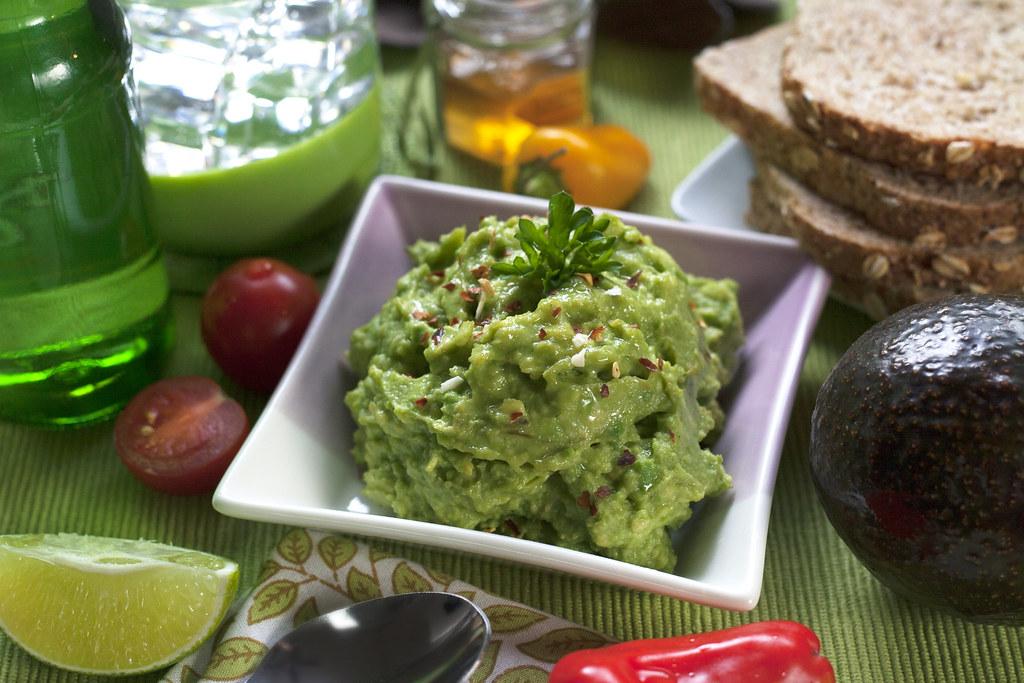
Illustrative licensed food photograph, not an official QDOBA product or evidence of current US portions, availability or prices.Guacamole. Photo: Kjokkenutstyr.net · Source · CC BY-SA 2.0 · Display cropped to fit.
Equal calories can hide a different comparison
The 2-ounce guacamole and Three Cheese Queso entries each contribute 80 calories, but they are not nutritionally identical. At those documented portions, guacamole has 160 milligrams of sodium versus queso's 340 milligrams, a difference of 180 milligrams. Queso lists 3 grams of protein versus guacamole's 1 gram, while guacamole lists 5 grams of carbohydrates versus queso's 3 grams. Both list 8 grams of fat. Consequently, the two chips combinations each total 640 calories but differ in their other columns. This is a useful comparison when choosing a dip you enjoy: the calorie total alone does not describe the entire order. It also does not establish ingredient suitability, allergen safety or whether either choice fits a personal medical target.
Use the published dip size rather than forcing a multiplier
Two published 2-ounce portions do not always match the separately published 4-ounce entry exactly. Three Cheese Queso is listed at 80 calories for 2 ounces and 170 calories for 4 ounces, not 160. Guacamole similarly lists 80 and 170 calories. Use the entry corresponding to the documented portion you are counting instead of silently replacing it with doubled smaller values. If you eat half of a 4-ounce queso portion, your proportional estimate is 85 calories, whereas the independently published 2-ounce queso entry is 80. Those statements describe different calculation methods. The distinction is small here, but it prevents false precision and keeps your food record consistent. Published rounding is a reason to preserve the source values, not to rewrite them.
Sharing the entire combination equally
Suppose two people share exactly the reference amounts of 4 ounces of chips and 4 ounces of Three Cheese Queso. The component sum is 730 calories, so an equal half is an estimated 365 calories per person. Half the combined nutrition is 6.5 grams of protein, 40 grams of carbohydrates, 21.5 grams of fat and 445 milligrams of sodium. If three people divide that same combination equally, each share is approximately 243 calories. These calculations require equal sharing of both components. They do not become accurate merely because two or three people sat at the table. Someone taking more chips or using more dip changes the split. Record the assumption as equal sharing rather than presenting each person's amount as a restaurant-published serving.
Illustrative licensed food photograph, not an official restaurant product or evidence of serving size, availability or prices.Burrito chihuahuense de chile verde.jpg. Photo: Levi bernardo · Source · CC BY-SA 4.0 · Display cropped to fit.
Put the side back into the full meal
A chips calculation is a side calculation, not automatically a lunch total. If your entrée estimate is 600 calories and you add the documented 4-ounce chips serving, the arithmetic becomes 1,160 calories before any dip or drink. Adding the published 2-ounce Three Cheese Queso entry takes that example to 1,240. Alternatively, an estimated quarter of the chips serving plus the same 2-ounce queso entry adds 220 calories, making the example meal 820. The 600-calorie entrée here is only an illustrative starting number, not a named QDOBA recipe. The useful comparison is the change made by the side. Keeping the entrée constant shows that eating a quarter rather than all of the chips reference changes the estimate by 420 calories.
FAQ: Are tortilla strips the same as chips?
No. QDOBA lists Tortilla Strips as a separate 0.5-ounce entry with 70 calories, 1 gram of protein, 8 grams of carbohydrates, 4.5 grams of fat and 35 milligrams of sodium. The chips reference is eight times as heavy by its ounce description, but the two products should still retain their own published entries. Do not use the strips row to infer the full nutrition of a bag of chips, and do not add chips when the food you actually chose was a strips topping. If you include both, count both. A salad with strips and a separate chips side has two distinct components, even though both contribute crunch. The ingredient name and portion are the reliable starting points.
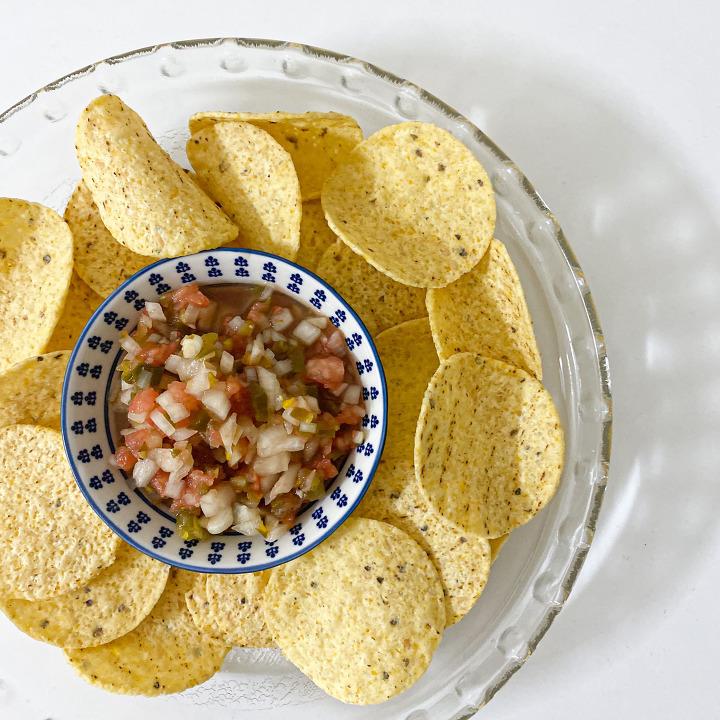
Illustrative licensed food photograph, not an official restaurant product or evidence of serving size, availability or prices.Homemade salsa with nachos 1.jpg. Photo: 에그란 · Source · CC BY 4.0 · Display cropped to fit.
FAQ: Does ordering dip on the side reduce calories?
Only eating less of it changes the amount consumed. Moving the same 2-ounce queso serving into a separate cup does not remove its published 80 calories. A side cup can make your chosen fraction easier to see, but its capacity does not prove its filled weight. If you use half of a portion, describe that as an estimate unless measured. Also check whether your entrée calculation already includes the dip as a topping. Counting that same portion again as a side would duplicate it, while omitting an additional cup would undercount the meal. Treat placement, purchased quantity and consumed quantity as separate questions. That approach is more useful than assuming that anything served outside the main container is nutritionally separate from lunch.
See the full QDOBA menu
Prices, calories and macros for every item, or build a meal in the calculator.
Sources and corrections
Nutrition figures on Well.now come from official US restaurant sources, linked on each brand page with a last-checked date. Prices use verified local amounts first, then clearly labeled sourced estimates; Varies appears when neither is available. See our sources and methodology, or email be@well.now with a correction.
About the Well.now Editorial Team
This article was written and fact-checked by the Well.now Editorial Team. We check nutrition claims against each chain's official US information and never publish prices we cannot confirm. Well.now is independent and not paid by any restaurant. Read our editorial policy.