 Nutrition
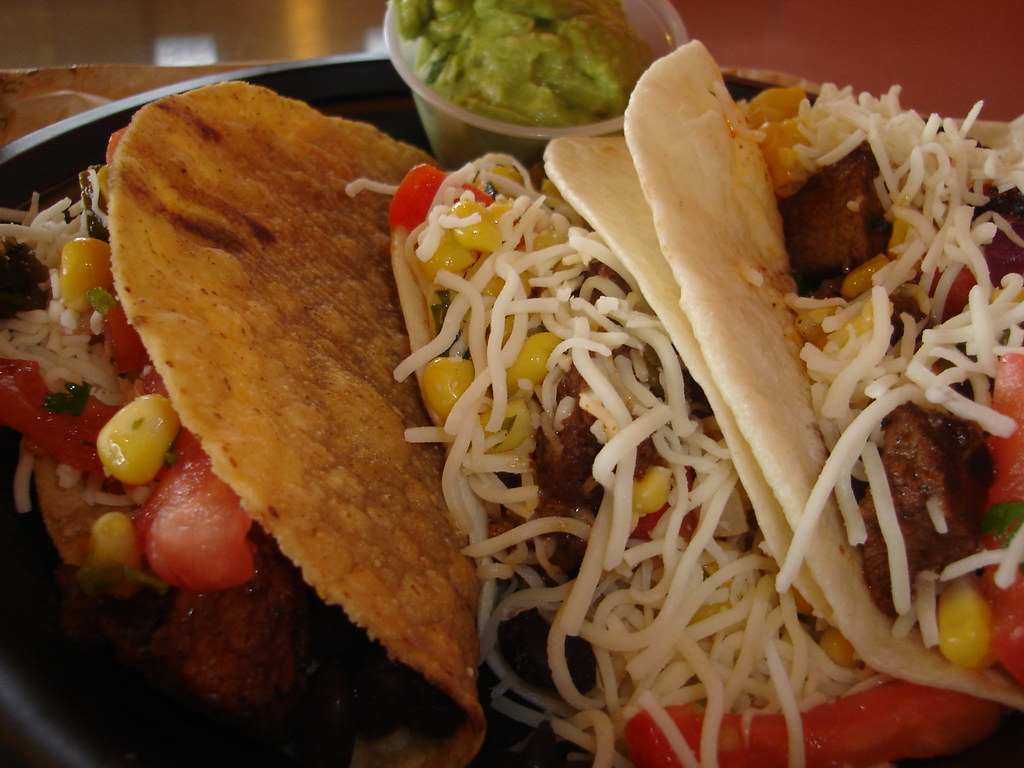
Illustrative licensed food photograph, not an official QDOBA product or evidence of current US portions, availability or prices.tres tacos. Photo: pheezy · Source · CC BY 2.0 · Display cropped to fit.
Official portions for this comparison
| Item / serving | Calories | Protein | Carbs | Fat | Sodium |
|---|---|---|---|---|---|
| Cilantro Lime Rice (4 oz.) | 190 | 3 g | 38 g | 2.5 g | 390 mg |
| Seasoned Brown Rice (4 oz.) | 170 | 4 g | 36 g | 1.5 g | 250 mg |
Ingredient portions are not complete entrées. Standard-portion combinations are calculated totals; changed portions are estimates. US source published February 26, 2026, checked November 8, 2026. Prices remain Varies without a verified local amount.
Official nutrition brochureWhat this guide covers
- QDOBA brown rice versus cilantro lime: the direct answer
- Official source and the limits of these rice entries
- Seasoned Brown Rice nutrition at 4 ounces
- Cilantro Lime Rice nutrition at 4 ounces
- Fix the rest of the bowl before changing rice
- The exact fixed-bowl totals with each rice
- Half-rice portions are estimates, not separate official entries
- Mixed rice and extra rice require explicit assumptions
- Removing rice or replacing it with beans
- FAQ: lower calories, lower carbs and fiber
- FAQ: calorie rounding and practical logging
QDOBA brown rice versus cilantro lime: the direct answer
QDOBA Seasoned Brown Rice has 170 calories per published 4-ounce serving, while Cilantro Lime Rice has 190 calories at the same published weight. Brown rice therefore has 20 fewer calories per reference serving. It also has 2 grams less carbohydrate, 1 gram more protein, 1 gram less fat and 140 milligrams less sodium. Those are comparisons between QDOBA's actual entries, not assumptions about plain brown and white rice cooked at home. In a bowl where every other ingredient stays fixed, switching from Cilantro Lime Rice to Seasoned Brown Rice changes the finished total by exactly those amounts. Rice does not need to be removed to make that comparison. Keeping the serving weight at 4 ounces lets you evaluate the recipe choice separately from the amount of food. Changing both the rice type and its quantity at once answers a different, combined question.
Official source and the limits of these rice entries
The source is the QDOBA US Nutrition Brochure dated February 26, 2026, checked November 8, 2026: the official brochure linked in the source panel. Both rice entries specify 4 ounces. The supplied data do not include independently published 2-ounce or 8-ounce rice entries, so smaller and larger quantities discussed here are proportional estimates. This article retains the published calorie figures rather than recalculating them from rounded macro grams. It also does not supply fiber or sugar values omitted from our local calculator dataset. The names matter: Seasoned Brown Rice and Cilantro Lime Rice are restaurant preparations, not generic grain entries. Selecting a plain-rice database substitute would discard the specific sodium and other nutrition values that make this comparison useful for a QDOBA order.
Seasoned Brown Rice nutrition at 4 ounces
The published 4-ounce Seasoned Brown Rice serving contains 170 calories, 4 grams of protein, 36 grams of carbohydrate, 1.5 grams of fat and 250 milligrams of sodium. These figures are the rice contribution before beans, meat, vegetables, salsa or toppings. If a rice-free set of bowl ingredients totals 400 calories, adding this serving gives a calculated 570-calorie bowl. It also adds the full 36 grams of carbohydrate and 250 milligrams of sodium. Brown rice should not be logged as zero sodium simply because unseasoned grain can be prepared without salt. The restaurant entry is the relevant reference here. Nor does its name establish a fiber number: the dataset used for this article does not supply one. The source supports a comparison of the listed calories, protein, total carbohydrate, fat and sodium, which is enough to quantify the fixed-portion swap without inventing additional nutritional advantages.
Illustrative licensed food photograph, not an official QDOBA product or evidence of current US portions, availability or prices.mini tacos. Photo: ginnerobot · Source · CC BY-SA 2.0 · Display cropped to fit.
Cilantro Lime Rice nutrition at 4 ounces
The published 4-ounce Cilantro Lime Rice serving contains 190 calories, 3 grams of protein, 38 grams of carbohydrate, 2.5 grams of fat and 390 milligrams of sodium. Relative to Seasoned Brown Rice, that is 20 more calories, 1 gram less protein, 2 grams more carbohydrate, 1 gram more fat and 140 milligrams more sodium. Going in the opposite direction reverses each sign. The calorie reduction from choosing brown rice is approximately 10.5% of the cilantro lime serving's 190 calories, but it is not a 10.5% reduction in an entire bowl. A bowl contains other ingredients that remain unchanged. The straightforward absolute difference, 20 calories per published serving, is usually more useful than a percentage. For sodium, the 140-milligram difference belongs to this particular pair of prepared rice recipes and should not be generalized to every brown-versus-white rice comparison.
Fix the rest of the bowl before changing rice
Use a consistent rice-free base of 4 ounces of Black Beans, 3.5 ounces of Grilled Adobo Chicken, 2 ounces of Fajita Veggies and 1 ounce of Pico de Gallo. Those four entries sum to 375 calories, 29 grams of protein, 30 grams of carbohydrate, 16 grams of fat and 955 milligrams of sodium. This is a custom calculation, not an official named entrée. It is useful because it gives both rice choices the same starting point. No queso, guacamole, shredded cheese, dressing, tortilla or chips are hidden in the baseline. If you add any of those, add the same portion to both versions when your goal is to isolate the rice. Otherwise, a difference attributed to rice may actually include a larger topping change. Writing down the baseline once also makes it easier to compare a full serving, a half-portion estimate and a no-rice version.
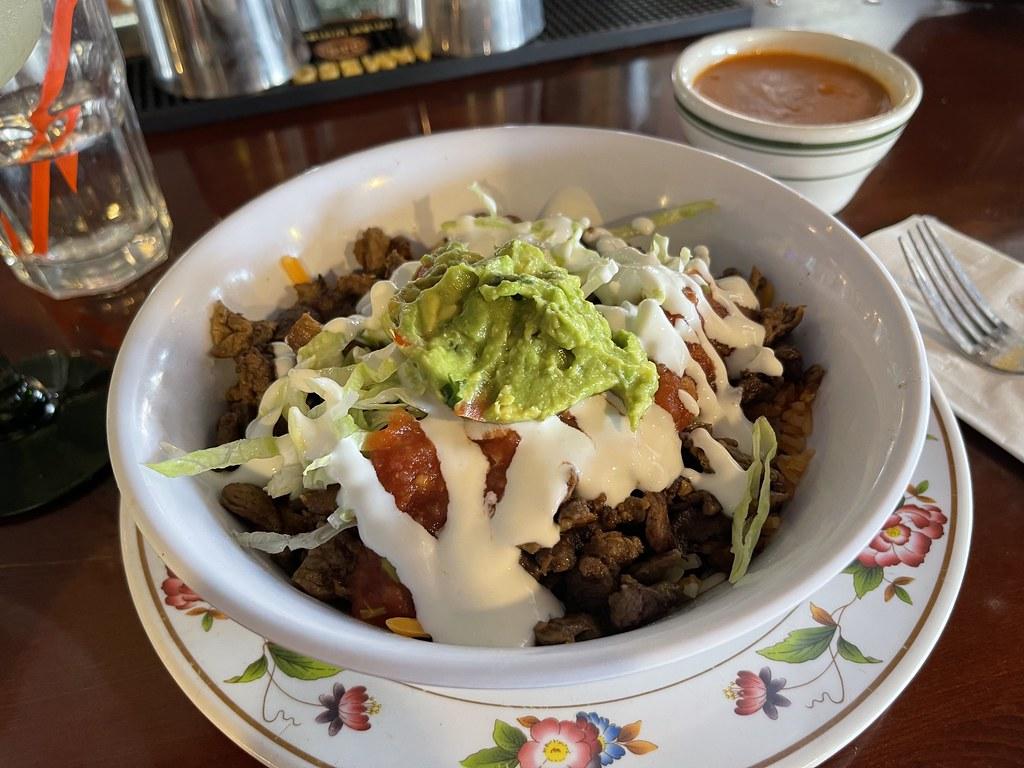
Illustrative licensed food photograph, not an official QDOBA product or evidence of current US portions, availability or prices.Tacos al Pastor. Photo: Ari Helminen · Source · CC BY 2.0 · Display cropped to fit.
The exact fixed-bowl totals with each rice
Add the published 4-ounce Seasoned Brown Rice serving to that fixed base and the bowl totals 545 calories, 33 grams of protein, 66 grams of carbohydrate, 17.5 grams of fat and 1,205 milligrams of sodium. Add the published 4-ounce Cilantro Lime Rice serving instead and the result is 565 calories, 32 grams of protein, 68 grams of carbohydrate, 18.5 grams of fat and 1,345 milligrams of sodium. The difference remains 20 calories and 140 milligrams of sodium, just as it was for rice alone. The other ingredients have not amplified or reduced the absolute difference. They have changed its share of the total: 20 calories is about 3.5% of the 565-calorie cilantro lime bowl. That percentage describes this example only. A different protein or additional toppings would change the bowl percentage without changing the documented rice-to-rice difference.
Half-rice portions are estimates, not separate official entries
A proportional half serving of Seasoned Brown Rice is an estimated 85 calories, 2 grams of protein, 18 grams of carbohydrate, 0.75 gram of fat and 125 milligrams of sodium. A proportional half serving of Cilantro Lime Rice is an estimated 95 calories, 1.5 grams of protein, 19 grams of carbohydrate, 1.25 grams of fat and 195 milligrams of sodium. These represent half of the respective 4-ounce reference entries, not independently published 2-ounce products. In the fixed bowl, half brown rice gives an estimated 460 calories and 1,080 milligrams of sodium; half cilantro lime gives 470 calories and 1,150 milligrams. The rice-to-rice difference is then an estimated 10 calories and 70 milligrams of sodium. Asking for light rice does not verify an exact half portion, so the precision belongs to the arithmetic, not to a guarantee about the amount served.
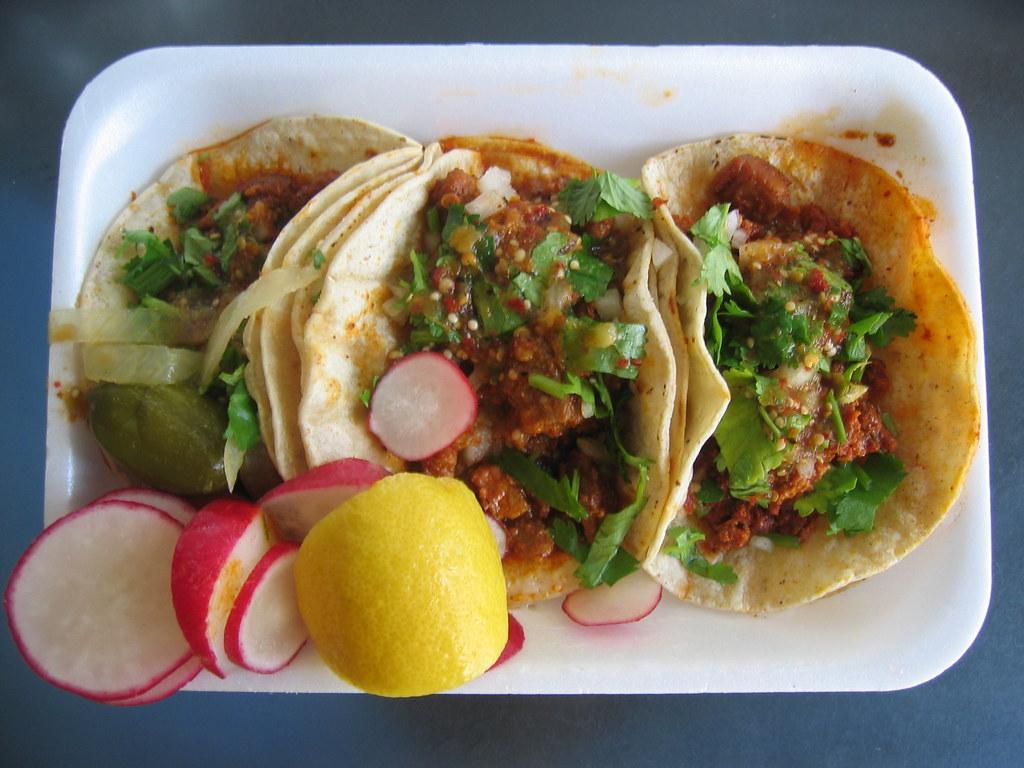
Illustrative licensed food photograph, not an official restaurant product or evidence of serving size, availability or prices.Burrito chihuahuense de chile verde.jpg. Photo: Levi bernardo · Source · CC BY-SA 4.0 · Display cropped to fit.
Mixed rice and extra rice require explicit assumptions
If a mixed-rice model contains an estimated 2 ounces of each rice, its rice component totals 180 calories, 3.5 grams of protein, 37 grams of carbohydrate, 2 grams of fat and 320 milligrams of sodium. Added to the fixed base, that produces an estimated 555-calorie bowl with 1,275 milligrams of sodium. This is a half-and-half calculation, not a separately published QDOBA blend. A modeled double reference portion gives different totals: two brown rice portions contribute an estimated 340 calories and 500 milligrams of sodium, while two cilantro lime portions contribute 380 calories and 780 milligrams. There is no independent 8-ounce entry in the checked data to confirm those modeled larger servings. Also, asking for both rices does not by itself establish whether the restaurant will serve one combined reference portion or two full ones. The assumed total weight must be stated before the arithmetic is meaningful.
Removing rice or replacing it with beans
Removing the full brown rice reference portion from the fixed bowl returns it from 545 to 375 calories and removes 36 grams of carbohydrate and 250 milligrams of sodium. Removing cilantro lime instead returns its 565-calorie version to the same baseline and removes 38 grams of carbohydrate and 390 milligrams of sodium. Replacing rice with another food is different. A 4-ounce Black Beans serving contains 140 calories, 9 grams of protein, 24 grams of carbohydrate, 1 gram of fat and 330 milligrams of sodium. Replacing 4 ounces of brown rice with that bean serving lowers calories by 30 and carbohydrate by 12 grams, raises protein by 5 grams and sodium by 80 milligrams, and lowers fat by 0.5 gram. Because the example bowl already contains black beans, this substitution would mean a second bean reference portion. It should not be described as simply choosing beans instead of having any.
Illustrative licensed food photograph, not an official restaurant product or evidence of serving size, availability or prices.Homemade salsa with nachos 1.jpg. Photo: 에그란 · Source · CC BY 4.0 · Display cropped to fit.
FAQ: lower calories, lower carbs and fiber
Which QDOBA rice has fewer calories? Seasoned Brown Rice, at 170 calories versus 190 per published 4-ounce serving. Which has fewer carbohydrates? Brown rice has 36 grams versus cilantro lime's 38 grams, a 2-gram difference. Which has more protein? Brown rice lists 4 grams versus 3 grams. Can you say how much more fiber brown rice provides? Not from these entries, because no fiber values are supplied. A general expectation about whole grains should not be converted into an invented QDOBA fiber figure. Are either of these plain, sodium-free rice portions? No. The source lists 250 milligrams of sodium for brown rice and 390 for cilantro lime. Does lower carbohydrate automatically mean lower sodium in every substitution? No. The rice-to-beans example shows a change that reduces carbohydrate while increasing sodium relative to brown rice. Each nutrient needs its own comparison rather than being inferred from another.
FAQ: calorie rounding and practical logging
Should the rice calories be recomputed from protein, carbohydrate and fat? No. Retain the published 170 and 190 calories even if a calculation using rounded macro grams differs. Is half rice an official 85- or 95-calorie menu item? Not in the checked source. Those are explicitly labeled proportional estimates. How should you compare two saved bowls? Duplicate the first bowl, change only the rice selection and confirm that both use the same 4-ounce reference size. If you also reduce the serving, report that as a second change. Should a rice substitution be applied to a named bowl's total without checking its ingredients? No. First establish the rice already represented in that complete-item entry. For a custom calculation, the clearest record lists rice type, rice portion and the unchanged bowl base separately. That preserves the small but exact recipe difference without confusing it with larger changes in toppings or portion size.
See the full QDOBA menu
Prices, calories and macros for every item, or build a meal in the calculator.
Sources and corrections
Nutrition figures on Well.now come from official US restaurant sources, linked on each brand page with a last-checked date. Prices use verified local amounts first, then clearly labeled sourced estimates; Varies appears when neither is available. See our sources and methodology, or email be@well.now with a correction.
About the Well.now Editorial Team
This article was written and fact-checked by the Well.now Editorial Team. We check nutrition claims against each chain's official US information and never publish prices we cannot confirm. Well.now is independent and not paid by any restaurant. Read our editorial policy.