 Nutrition
Illustrative licensed food photograph, not an official Golden Corral product or evidence of US portions, current availability or prices.Pork Chop Breakfast, Egg Patty, Bacon, Cheddar Cheese, Green Beans. Photo: diettogo1 · Source · CC BY-SA 2.0 · Display cropped to fit.
Golden Corral sources and plate planning
Official US nutrition database checked 2026-11-15. No separate nutrition effective date confirmed. These are published recipe servings, not weighed buffet portions or guaranteed local offerings. Plate totals are calculated estimates. Blank allergen records do not mean allergen-free. Unconfirmed admission prices remain Varies.
Golden Corral official nutrition database ↗What this guide covers
- Think beyond the entrée listing
- Read the official serving beside the calories
- Concrete source servings to compare
- Choose the exact preparation before comparing
- Compare equal amounts when the question calls for it
- Use one-variable swaps to learn what matters
- Give vegetables an exact identity too
- Count rich sides by intention, not by accident
- Distinguish included sauce from added sauce
- Make beverage calories visible
- Plan dessert as a choice, not a surprise
- Treat seconds as part of the same meal
- Read calories alongside other priorities
- Keep availability and dietary safety separate
- Use the estimate to make one better-informed decision
Think beyond the entrée listing
Looking up Golden Corral calories is useful, but a single entrée number rarely describes a buffet meal. Your actual meal may include several sides, something from the salad bar, a roll, a beverage, and a return visit for another favorite. The most practical approach is to treat each listing as a building block rather than a complete answer. Start with what you want to eat, identify the matching entries, and combine realistic portions. This keeps calorie information connected to the meal in front of you. It also makes room for enjoyment, because you can compare different ways to include a favorite instead of assuming it must be excluded.
Read the official serving beside the calories
The official Golden Corral nutrition page publishes calories together with serving descriptions and other nutrient information. The serving is essential context: a lower listed value may simply describe a smaller amount of food. This article follows the supplied dataset edition labeled checked November 15, 2026, while no separate nutrition-data effective date is confirmed. Published serving values should therefore be distinguished from estimates for your own plate. If you serve more or less than the reference amount, the corresponding meal calculation changes. Reading the calories without the serving can create misleading comparisons even when every number has been copied correctly from the source.
Concrete source servings to compare
The source lists Bourbon Street Chicken (3 oz) at 170 calories, 19 grams protein, 4 grams carbohydrate, 9 grams fat and 350 milligrams sodium, with a stated weight of 85g. The source lists Fried Chicken (3 oz) at 240 calories, 19 grams protein, 6 grams carbohydrate, 15 grams fat and 460 milligrams sodium, with a stated weight of 85g. These are exact published reference servings, not measurements of the food on your buffet plate. Keep the different weights visible rather than ranking unequal amounts as though they were identical. Select the matching entries in the calculator to compare the whole meal, including any separately added toppings. The resulting plate total remains a calculated estimate because self-served quantities can differ from the source. Current local availability must also be confirmed separately; a database listing is not a promise that the dish is on today’s buffet.
Choose the exact preparation before comparing
Food names that share a main ingredient do not necessarily describe comparable dishes. Steak with a coating is different from a grilled steak preparation, and chicken with a named sauce should not be logged as an unspecified chicken portion. Search for the whole dish name and examine descriptors that identify cooking method, cut, or included accompaniments. If you cannot match the buffet label confidently, ask what the preparation is called. Avoid selecting whichever entry gives the result you prefer. A calorie comparison only becomes useful when the entries describe the foods you would actually choose, in portions that resemble what you intend to put on your plate.

Illustrative licensed food photograph, not an official Golden Corral product or evidence of US portions, current availability or prices.Breakfast, eggs benedicto. Photo: moonrat42 · Source · CC BY-SA 2.0 · Display cropped to fit.
Compare equal amounts when the question calls for it
There are two legitimate comparisons, and they answer different questions. Comparing equal weights helps you understand how preparations differ for the same amount of food. Comparing the actual portions you expect to eat helps you estimate your meal. Do not confuse those approaches. A larger serving of a lower-calorie preparation can still contribute more calories than a smaller serving of another dish. Conversely, choosing a published portion that is naturally easy to identify may make your estimate more dependable. The portion-size guide explains how to interpret pieces, weights, and scoops without treating a buffet utensil as a calibrated measuring device.
Use one-variable swaps to learn what matters
When you want to lower an estimated meal total, change one component first. Keep the entrée, drink, and other sides in place while comparing a different side or a smaller portion of the same one. This shows whether the change is worthwhile to you. Replacing the entire meal may produce a lower total, but it does not reveal which adjustment made the difference or whether you would enjoy the result. The Golden Corral nutrition calculator can support this process by holding the rest of the meal constant. Favor changes you would willingly repeat over an unfamiliar combination selected only because its displayed number is smaller.
Give vegetables an exact identity too
Vegetables should not disappear into a generic mental category when you estimate calories. A prepared vegetable dish may include sauce, cheese, oil, butter, or other ingredients reflected in its published entry. Match the preparation rather than assuming every item with the same vegetable name is interchangeable. At the salad bar, distinguish the vegetables themselves from dressing, cheese, seeds, croutons, or other additions you choose separately. This is not a reason to avoid any particular topping. It is a way to understand the finished dish. A salad assembled from several components should be calculated as that combination, unless the source provides a matching complete salad entry.

Illustrative licensed food photograph, not an official Golden Corral product or evidence of US portions, current availability or prices.American food - Breakfast - Eggs and Toast. Photo: nickgraywfu · Source · CC BY-SA 2.0 · Display cropped to fit.
Count rich sides by intention, not by accident
Comfort-food sides can fit into a planned buffet meal, but they are easier to estimate when each has a deliberate role. Decide which side you most want instead of collecting a full portion of every appealing option. If you want a tasting plate, make the servings visibly small and keep track of them as separate foods. Several casual spoonfuls can be difficult to reconstruct later, especially when they blend together. A useful question is whether you want more variety or more of one favorite. Either answer can guide a plate that feels satisfying while remaining understandable in the calculator. The goal is clearer choices, not a rule against richer foods.
Distinguish included sauce from added sauce
Calories from sauces can be missed when they are treated as decoration, but they can also be duplicated when a sauced dish is logged incorrectly. Read whether the source entry already describes gravy, glaze, dressing, or another accompaniment. Add a separate entry only for an additional component that is not represented in the selected dish. If you pour extra sauce over an entrée, include that addition using the closest verified serving description. If the recipe breakdown is unclear, state the uncertainty instead of subtracting ingredients you assume are present. Removing a visible topping does not automatically justify recalculating the restaurant's recipe as though every ingredient contribution were known.
Make beverage calories visible
Your beverage belongs in the same meal estimate as your food. Include refills and additions rather than treating the first glass as the entire beverage portion. If you choose water, it can simplify the comparison by leaving the foods as the main variables. If you prefer another drink, account for it without treating that choice as a failure. Exact drink matching still matters: an uncertain cup size or an unspecified sweetened beverage is not a verified serving. When information is missing, acknowledge that the total is incomplete. A transparent estimate with one unresolved component is more useful than a confident total built from an unrelated beverage entry.
Illustrative licensed food photo, not an official Golden Corral product, portion or price.While our pilgrims walked with another guide, I was busy with lunch! Hope they are hungry. #frescotours. Photo: Fresco Tours · Source · CC BY 2.0 · Display cropped to fit.
Plan dessert as a choice, not a surprise
If dessert is part of what you enjoy about a buffet visit, include it in your plan from the beginning. You do not need to decide that the first plate must use every food you might want. Looking at dessert options before committing to several sides can help you decide where your preferences lie. Match the specific dessert and its serving description, especially when slices, scoops, toppings, or mixed creations vary. A small portion of a favorite may be more satisfying than several substitutes chosen only for their names. The calculator should reflect what you actually select, including toppings, rather than assigning one generic dessert value to any sweet finish.
Treat seconds as part of the same meal
A second plate may look modest while still changing the total substantially, depending on what it contains and how much you serve. Record the return trip rather than mentally separating it from the original meal. Before getting up, identify what you want: another portion of the entrée, a missing side, or a taste you have not tried. This helps prevent a second full assortment assembled simply because the buffet remains available. You can also wait and assess whether you want more food at all. The lower-calorie plate guide offers practical ways to structure that decision without making the first plate unnecessarily sparse or unsatisfying.
Read calories alongside other priorities
Calories describe one aspect of a meal, not its entire nutritional value or suitability for you. If protein, carbohydrate, sodium, or another nutrient matters to your planning, compare that information alongside the calorie total. A choice can lower calories while moving another nutrient in a direction you did not intend. Likewise, a higher-calorie meal may better match your appetite or another personal priority. Explore the high-protein guide and sodium guide for more focused comparisons. Avoid assuming a single label such as grilled, salad, or low-carb answers every nutrition question. The exact dish, serving, and full meal remain the useful units of comparison.
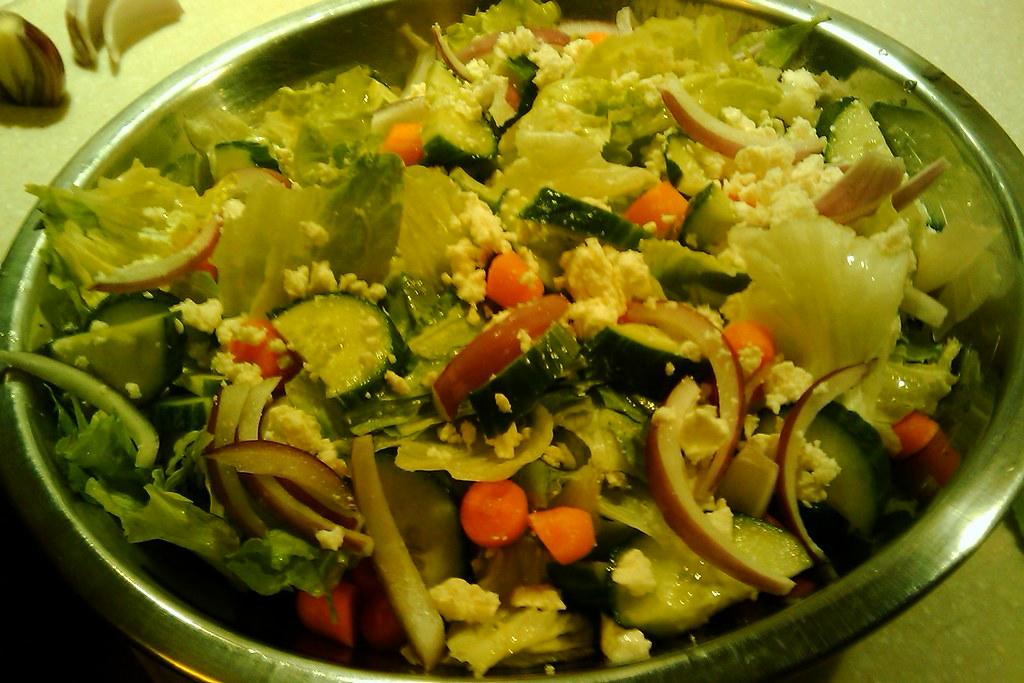
Illustrative licensed food photo, not an official Golden Corral product, portion or price.greek salad. Photo: julio.garciah · Source · CC BY 2.0 · Display cropped to fit.
Keep availability and dietary safety separate
A calorie listing does not confirm that a dish is available at every restaurant or during every service. Use the official website as a starting point and verify the choices at your location. For budget planning, consult the separate Golden Corral menu and prices guide rather than drawing conclusions from nutrition listings. Calorie information also cannot establish whether a food is appropriate for an allergy. Shared preparation and a self-service buffet create cross-contact concerns, and cross-contact cannot be guaranteed absent. Ask restaurant staff about ingredients and handling, and do not interpret the presence or absence of a nutrient value as evidence of allergen safety.
Use the estimate to make one better-informed decision
The best calorie estimate is not necessarily the most elaborate one. It is the one that helps you make a decision you understand, such as choosing a preferred side, reducing an oversized serving, or including dessert intentionally. Review the meal for omitted drinks, extras, and return trips, then accept that unweighed buffet portions introduce uncertainty. Small numerical differences should not be treated as decisive when the serving estimates are rough. For a step-by-step workflow, use the calculator guide. Keep the published serving values intact, describe your customized plate total as a calculated estimate, and let the result inform your choices without pretending it measures the meal more precisely than it can.
See the full Golden Corral menu
Prices, calories and macros for every item, or build a meal in the calculator.
Sources and corrections
Nutrition figures on Well.now come from official US restaurant sources, linked on each brand page with a last-checked date. Prices use verified local amounts first, then clearly labeled sourced estimates; Varies appears when neither is available. See our sources and methodology, or email be@well.now with a correction.

About the Well.now Editorial Team
This article was written and fact-checked by the Well.now Editorial Team. We check nutrition claims against each chain's official US information and never publish prices we cannot confirm. Well.now is independent and not paid by any restaurant. Read our editorial policy.