 Nutrition
Illustrative licensed food photograph, not an official Golden Corral product or evidence of US portions, current availability or prices.The Red Grape is making housemade desserts again. Praise the food gods. This is divine: lemon curd cheesecake on Graham cracker crust with raspberry. #food #dessert #cake #Sonoma #sonomavalley. Photo: sarahstierch · Source · CC BY 2.0 · Display cropped to fit.
Golden Corral sources and plate planning
Official US nutrition database checked 2026-11-15. No separate nutrition effective date confirmed. These are published recipe servings, not weighed buffet portions or guaranteed local offerings. Plate totals are calculated estimates. Blank allergen records do not mean allergen-free. Unconfirmed admission prices remain Varies.
Golden Corral official nutrition database ↗What this guide covers
- Separate a published serving from your portion
- Read both the description and gram weight
- Concrete source servings to compare
- Understand weight-based entries
- Do not convert a buffet scoop automatically
- Count-based foods still need a specific match
- Keep complete dishes complete
- Distinguish the amount served from the amount eaten
- Give salad additions their own portions
- Handle sauces with a clear boundary
- Use multipliers only after identifying the unit
- Record return trips separately when helpful
- Use uncertainty to interpret close comparisons
- Keep availability and handling outside the portion estimate
- Make consistency more important than false exactness
Separate a published serving from your portion
At a self-service buffet, serving and portion are related but different ideas. A published serving is the reference amount used for a nutrition listing. Your portion is the amount you actually put on the plate and eat. They may be similar, but the buffet does not make them identical. Understanding that distinction improves every calorie, protein, carbohydrate, or sodium estimate you make at Golden Corral. It also prevents a common mistake: selecting a dish in a calculator and assuming the default quantity covers whatever amount you happened to serve. Start by reading the reference unit, then decide how closely your own portion resembles it before adjusting the calculation.
Read both the description and gram weight
The official Golden Corral nutrition page provides serving descriptions and gram weights alongside nutrient values. Those fields should be read together rather than treated as decorative details. This guide follows the supplied dataset edition labeled checked November 15, 2026; the page itself has no confirmed update date. The posted values describe published servings, while customized plate totals remain calculated estimates because self-serving weights vary. If a serving description and weight appear difficult to reconcile, do not silently choose whichever interpretation gives the preferred result. Seek clarification or use the entry cautiously, especially when the uncertainty would materially affect the meal comparison you are trying to make.
Concrete source servings to compare
The source lists Fried Chicken (3 oz) at 240 calories, 19 grams protein, 6 grams carbohydrate, 15 grams fat and 460 milligrams sodium, with a stated weight of 85g. The source lists Grilled Chicken Breast (10 oz) at 430 calories, 83 grams protein, 0 grams carbohydrate, 11 grams fat and 1370 milligrams sodium, with a stated weight of 283g. These are exact published reference servings, not measurements of the food on your buffet plate. Keep the different weights visible rather than ranking unequal amounts as though they were identical. Select the matching entries in the calculator to compare the whole meal, including any separately added toppings. The resulting plate total remains a calculated estimate because self-served quantities can differ from the source. Current local availability must also be confirmed separately; a database listing is not a promise that the dish is on today’s buffet.
Understand weight-based entries
A weight-based serving describes an amount of food, not a particular area of your plate. Slices can overlap, pieces can differ in thickness, and a loose pile can look larger than a compact one without necessarily weighing more. This makes visual estimation imperfect even when you know the listed unit. Avoid treating a familiar-looking piece as an exact match unless the source specifically defines it that way. If you have no way to measure the food, use a reasonable approximation and keep the result labeled accordingly. The main benefit of reading the weight is not to create certainty where none exists, but to understand what quantity the published nutrients actually represent.

Illustrative licensed food photograph, not an official Golden Corral product or evidence of US portions, current availability or prices.Dessert Cakes. Photo: ProFlowers.com · Source · CC BY 2.0 · Display cropped to fit.
Do not convert a buffet scoop automatically
A serving spoon or scoop is a transfer utensil, not necessarily a standardized portion measure. Its size, shape, fullness, and the food's texture can all affect the amount transferred. One level spoonful of a dense side is not equivalent to a heaped spoonful of a loose vegetable dish. Even repeated scoops from the same tray may differ. Read whether the nutrition source uses a volume measure, a weight, or another unit before assigning a multiplier. If you regularly estimate similar dishes, consistency in how you serve can make your comparisons more useful, but it still does not establish that the utensil matches the published serving exactly.
Count-based foods still need a specific match
A listing expressed as one piece or one item may seem straightforward, but the piece must be the one described by the source. A chicken cut, dessert slice, or prepared entrée can differ from another item in the same broad category. Do not use a count-based entry for any vaguely similar piece simply because counting is easier than estimating weight. Check the full name and serving details first. When the item genuinely matches, count-based entries can simplify tracking, especially for separate return trips. They still represent published reference portions rather than a guarantee that every piece on the buffet is identical in size or composition.
Keep complete dishes complete
Some entries describe a finished preparation rather than a single ingredient. A meat dish with vegetables and gravy, for example, should be matched to that complete preparation when that is what you take. Do not log only the visible meat while ignoring the rest, and do not add every named component again if the source already includes them. Mixed dishes can also be uneven: your serving may contain more solids or sauce than the reference. Acknowledge that variability rather than pretending the recipe can be reconstructed from appearance. The nutrition calculator guide explains how to preserve these distinctions when combining entries into a meal.
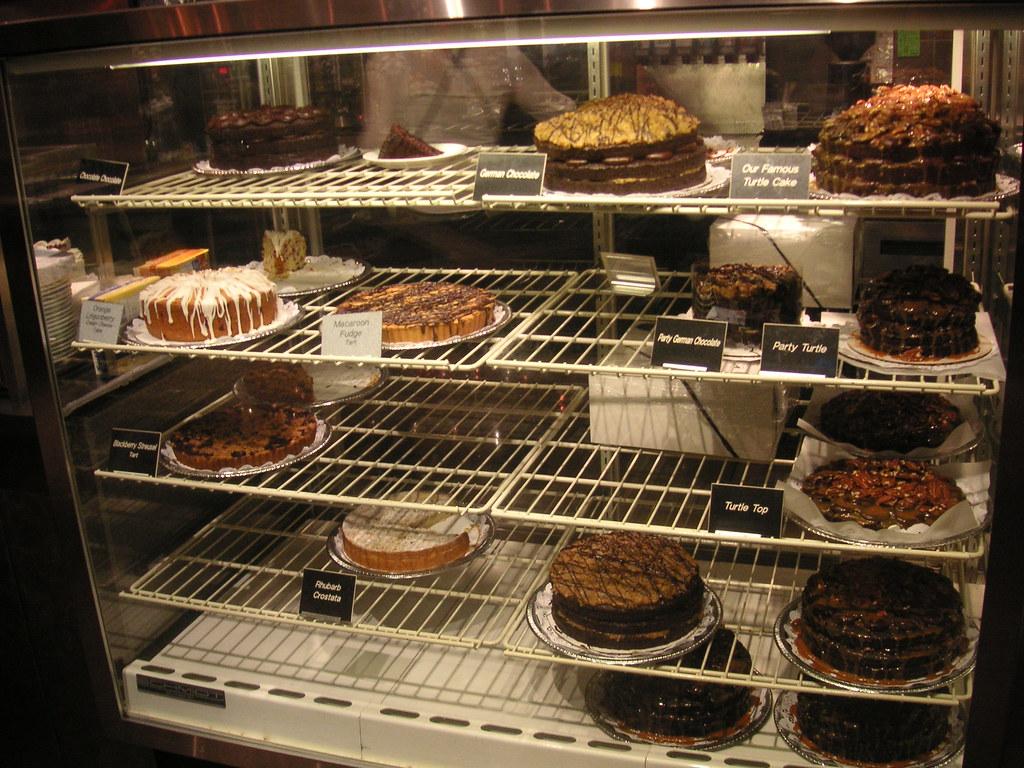
Illustrative licensed food photograph, not an official Golden Corral product or evidence of US portions, current availability or prices.Dessert cakes and pies. Photo: blmurch · Source · CC BY 2.0 · Display cropped to fit.
Distinguish the amount served from the amount eaten
The food placed on your plate is not always the same as the food you consume. Bones, inedible components, and uneaten leftovers can complicate a portion estimate. Read the source description rather than assuming whether a published weight includes every visible part of an item. If the listing does not clarify a point that matters to your calculation, avoid inventing a conversion. Similarly, leaving some food behind may change your intake, but the amount cannot always be reconstructed precisely afterward. It is often easier to begin with a deliberate serving and add more if wanted than to take an oversized portion and later estimate how much remained.
Give salad additions their own portions
An assembled salad can contain many separately served ingredients, each with its own amount. The bowl or plate size does not reveal the quantity of dressing, cheese, croutons, protein toppings, or other additions. Enter the components that are separate, using matching source entries where available. If you select a complete prepared salad, do not automatically rebuild it from assumed ingredients instead. This distinction is especially useful when comparing two salads that look similar but have different toppings. A vegetable base and a finished salad are not interchangeable units. The practical aim is to describe the combination you choose without treating everything in the salad area as one generic serving.
Handle sauces with a clear boundary
Decide whether a sauce is part of the listed dish or an extra addition before estimating its portion. A named sauced entrée may already include the preparation, while a separate ladle of gravy may need its own quantity. The ladle itself should not be assumed to equal the published unit. If you add a topping more than once, include the later amount as well. Avoid subtracting an imagined sauce portion from a complete entrée merely because you leave some liquid on the plate. Without verified component information, you cannot know exactly how the remaining food compares with an unsauced recipe that may not be represented by the source.
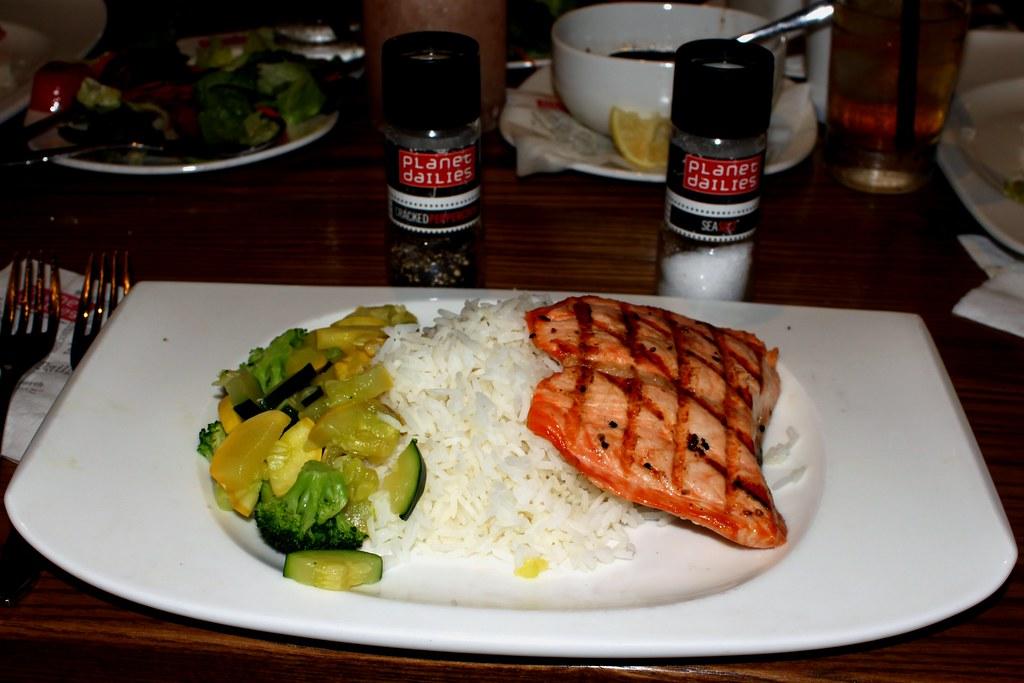
Illustrative licensed food photo, not an official Golden Corral product, portion or price.Grilled Teriyaki Salmon. Photo: Prayitno / Thank you for (12 millions +) view · Source · CC BY 2.0 · Display cropped to fit.
Use multipliers only after identifying the unit
A calculator multiplier scales the published serving; it does not define the serving for you. Entering two could mean two listed weights, two items, or two volume measures depending on the selected dish. Read the unit every time you choose a new entry, especially when moving between meats, sides, sauces, and desserts. Item quantities use whole numbers. In the plate builder, Light estimates half the published serving and Extra estimates twice the published serving; arbitrary fractional quantities and custom measured weights are not supported. The Golden Corral nutrition calculator is most useful when the quantities remain explainable in ordinary terms. If you cannot describe what a multiplier means on your plate, revisit the serving information before trusting the total.
Record return trips separately when helpful
A second helping does not have to match the first. You may take a smaller piece of the entrée, a different amount of a side, or only a taste of another dish. For another identical listed serving, increase the item quantity. If the second helping differs, use an available builder portion setting where appropriate and note any remaining uncertainty outside the calculator. Record the return while you still remember what was on the plate rather than reconstructing it after several trips. Before returning, identify what you actually want more of; that makes both serving and tracking more deliberate. The lower-calorie plate guide discusses this decision, but the portion principle applies regardless of whether your main interest is calories, protein, carbohydrate, or sodium.
Use uncertainty to interpret close comparisons
Two estimated plates may show slightly different totals even though their portion uncertainty is substantial. Do not treat a small displayed advantage as decisive when both meals depend on loosely estimated scoops or mixed dishes. A comparison between clearly different portions of the same food may be easier to interpret than one involving several uncertain substitutions. You can also compare a plausible smaller and larger amount to see whether your conclusion changes, provided both remain honest estimates. This is a way to understand sensitivity, not a claim that the true value lies within a guaranteed range. The calories guide explains why calculator precision should not be confused with measurement accuracy.
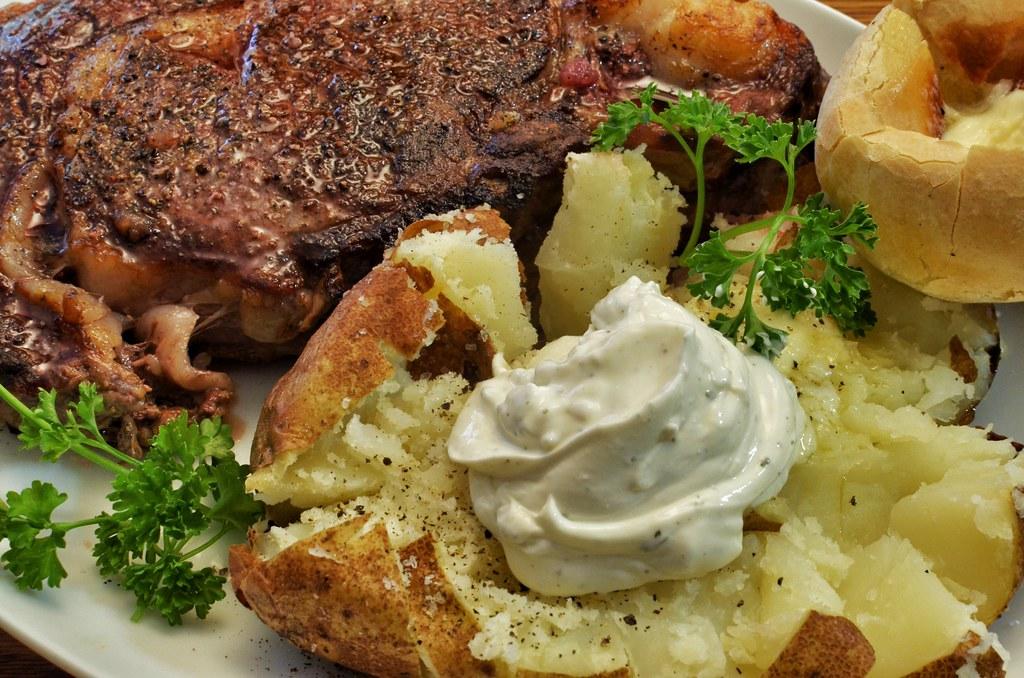
Illustrative licensed food photo, not an official Golden Corral product, portion or price.Mmm... ribeye and baked potato. Photo: jeffreyw · Source · CC BY 2.0 · Display cropped to fit.
Keep availability and handling outside the portion estimate
Knowing a published serving does not establish that the dish is currently available or that it meets an allergy-related need. Consult the official website and confirm offerings at your location before relying on a planned plate. Cross-contact cannot be guaranteed absent in a shared preparation and self-service setting; ask staff about ingredients and handling when those questions matter. Portion calculations cannot resolve them. For visit costs, use the separate Golden Corral menu and prices guide. Keeping these topics separate helps prevent a well-organized nutrition estimate from being mistaken for a broader guarantee about the restaurant experience.
Make consistency more important than false exactness
A practical portion routine is to identify the dish, read its unit, serve deliberately, and record extras and return trips while they are easy to remember. Keep the published nutrient values intact and describe your combined meal as an estimate. Over time, consistent serving decisions can make comparisons more useful even when exact weighing is unavailable. You do not need to pretend every piece, scoop, or slice matches a reference perfectly. The purpose is to understand the relationship between the food you choose and the source information you use. That foundation supports better comparisons across the protein guide, lower-carb guide, and sodium guide without promising precision the buffet cannot provide.
See the full Golden Corral menu
Prices, calories and macros for every item, or build a meal in the calculator.
Sources and corrections
Nutrition figures on Well.now come from official US restaurant sources, linked on each brand page with a last-checked date. Prices use verified local amounts first, then clearly labeled sourced estimates; Varies appears when neither is available. See our sources and methodology, or email be@well.now with a correction.

About the Well.now Editorial Team
This article was written and fact-checked by the Well.now Editorial Team. We check nutrition claims against each chain's official US information and never publish prices we cannot confirm. Well.now is independent and not paid by any restaurant. Read our editorial policy.